
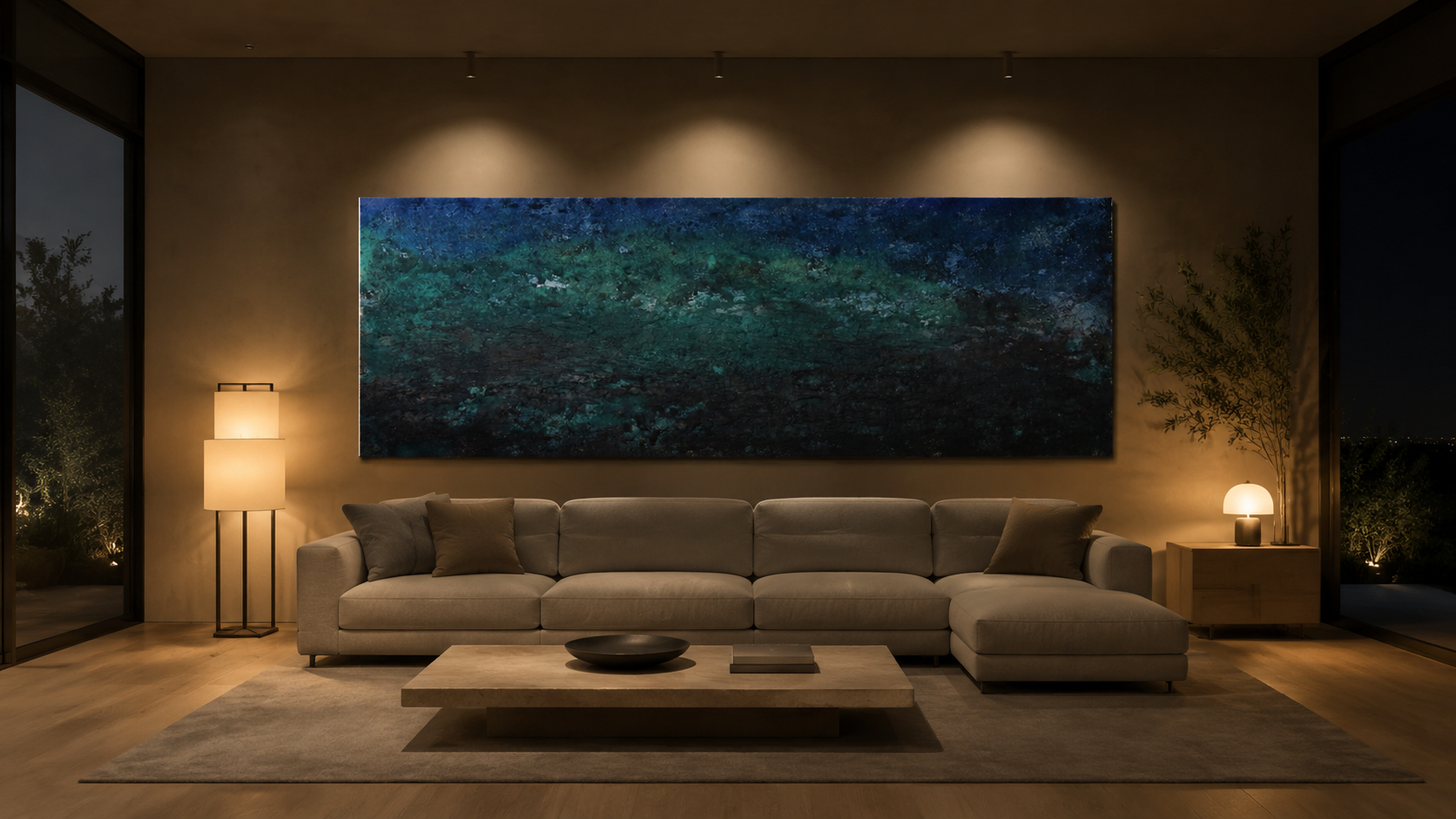
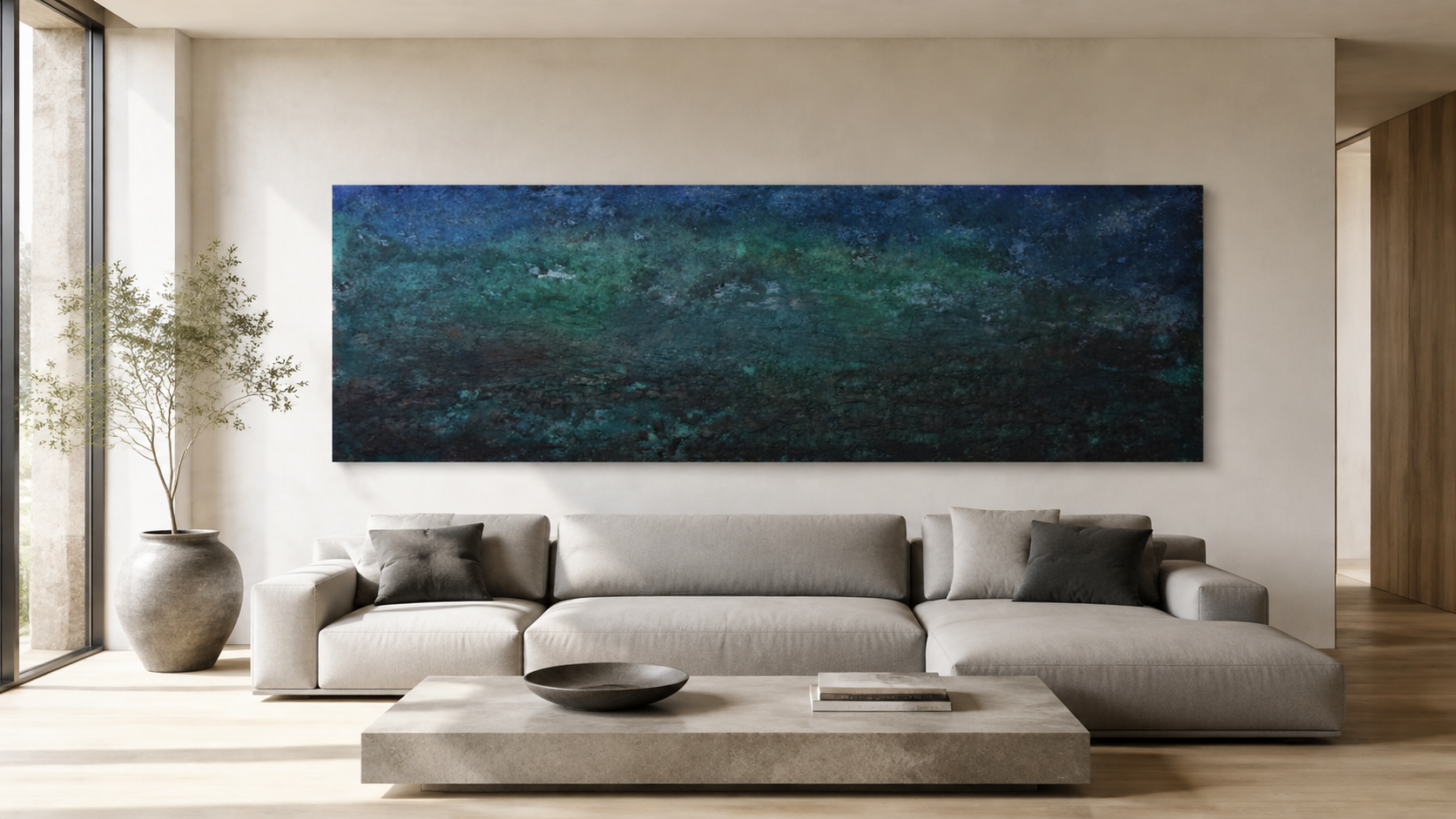
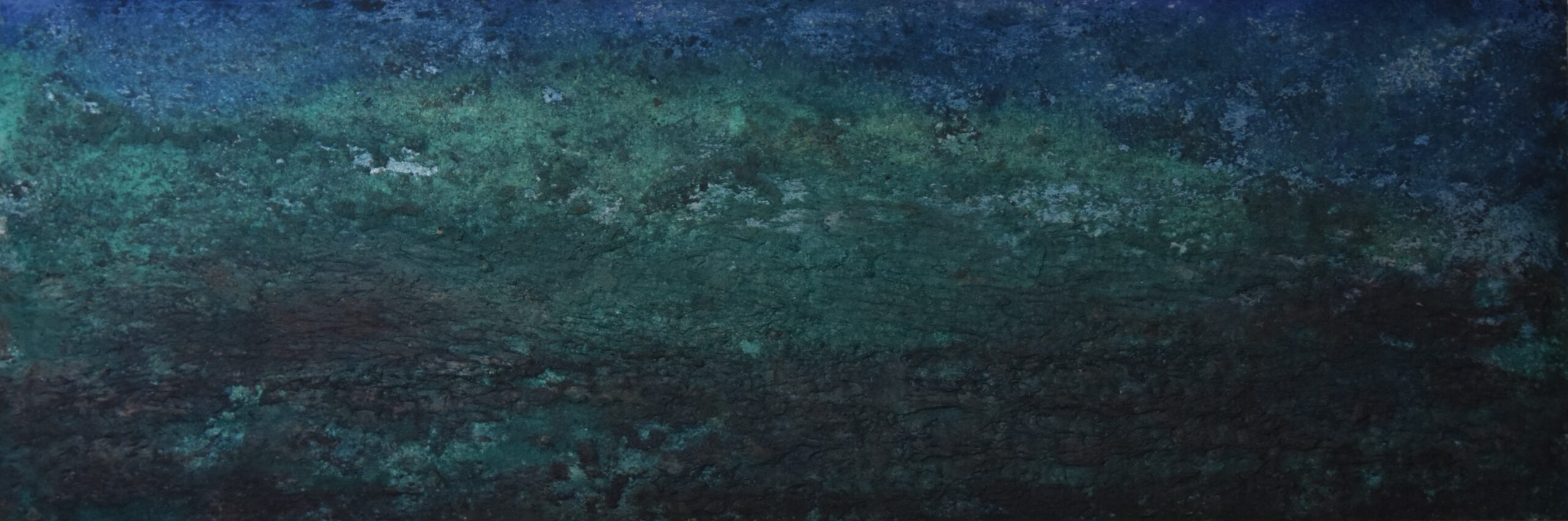

Perceptions1618 unfolds across nearly two and a half meters like a submerged horizon — deep cobalt at its upper edge dissolving into oxidized greens, then into a dense, near-black sediment along its base. The surface does not merely display color; it holds a physical history.
Gerardo Pochintesta intervenes the fiber support with acids and controlled variations in temperature, opening its structure to generate texture and volume before reconsolidating it with high-resistance plastic glues — a process that turns the support itself into topography.
Over this prepared ground, the artist applies oxides more than a century old, burned with acid and layered across 72 successive glazes in linseed oil, water, alcohol, and latex-based media. The entire composition is structured according to golden-mean proportion, giving the work an underlying architectural order beneath its atmospheric surface.
Perceptions1618 belongs to Pochintesta's Neuroquantum Art Collection — a body of work built on the premise that a painting's meaning is never fixed, but completed by the viewer. Its perception shifts according to the emotional and mental state of whoever stands before it: the same field of blue-green oxidation can read as calm one day, and as something far more turbulent the next. The observer does not simply view the work — they become its final, variable component.
Gerardo Pochintesta is a contemporary artist with over three decades of practice rooted in a rigorous, constructivist-influenced approach to abstraction. Across his career, his work has moved through distinct material and conceptual periods, always driven by a deep engagement with texture, structure, and the physical process of paint and matter transformed over time.
With Perceptions1618, Pochintesta extends this lifelong material investigation into a new conceptual territory: the Neuroquantum Art Collection, in which the artist proposes that perception itself — not the canvas — is where a painting is truly completed.