
Enduring When Everything Else Changes
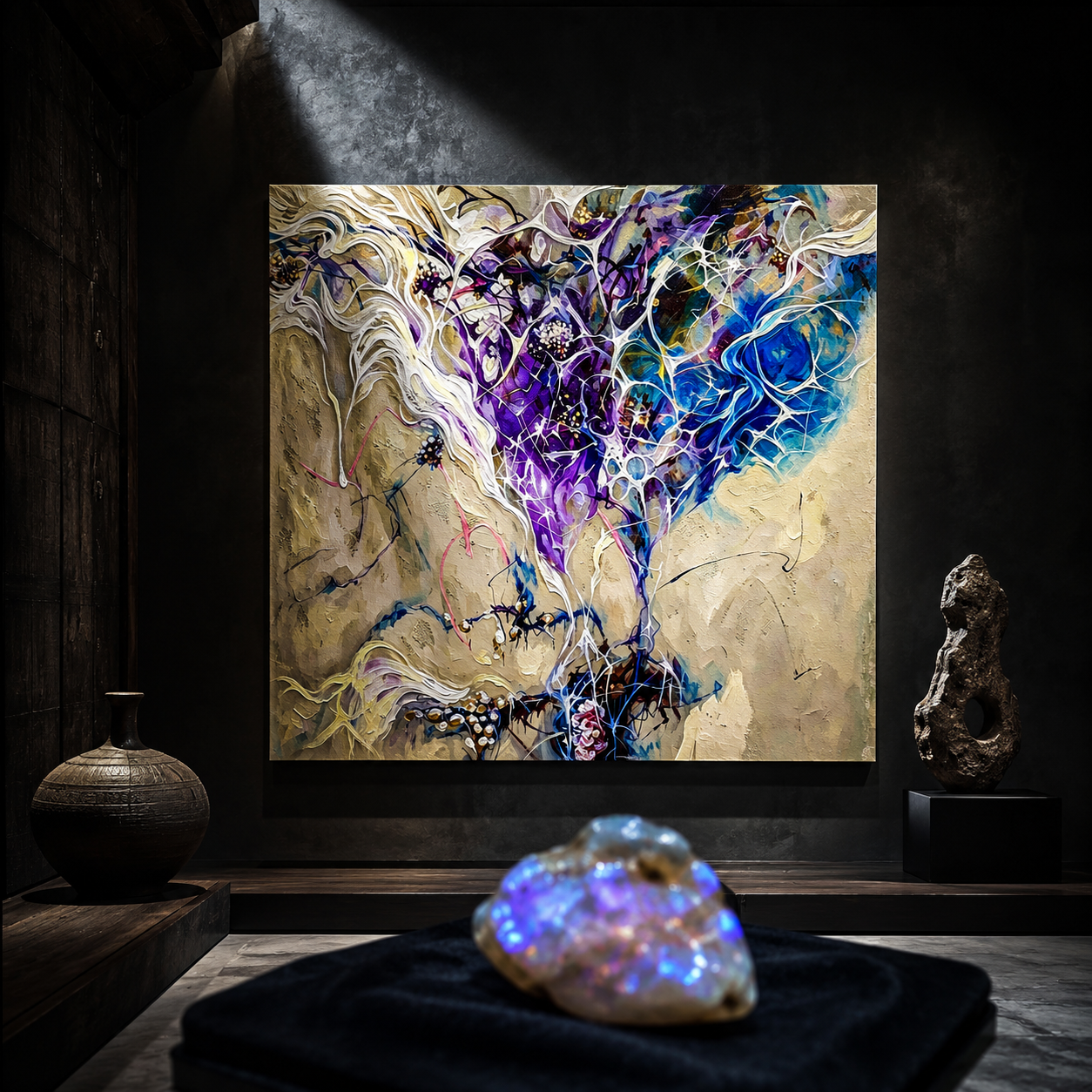
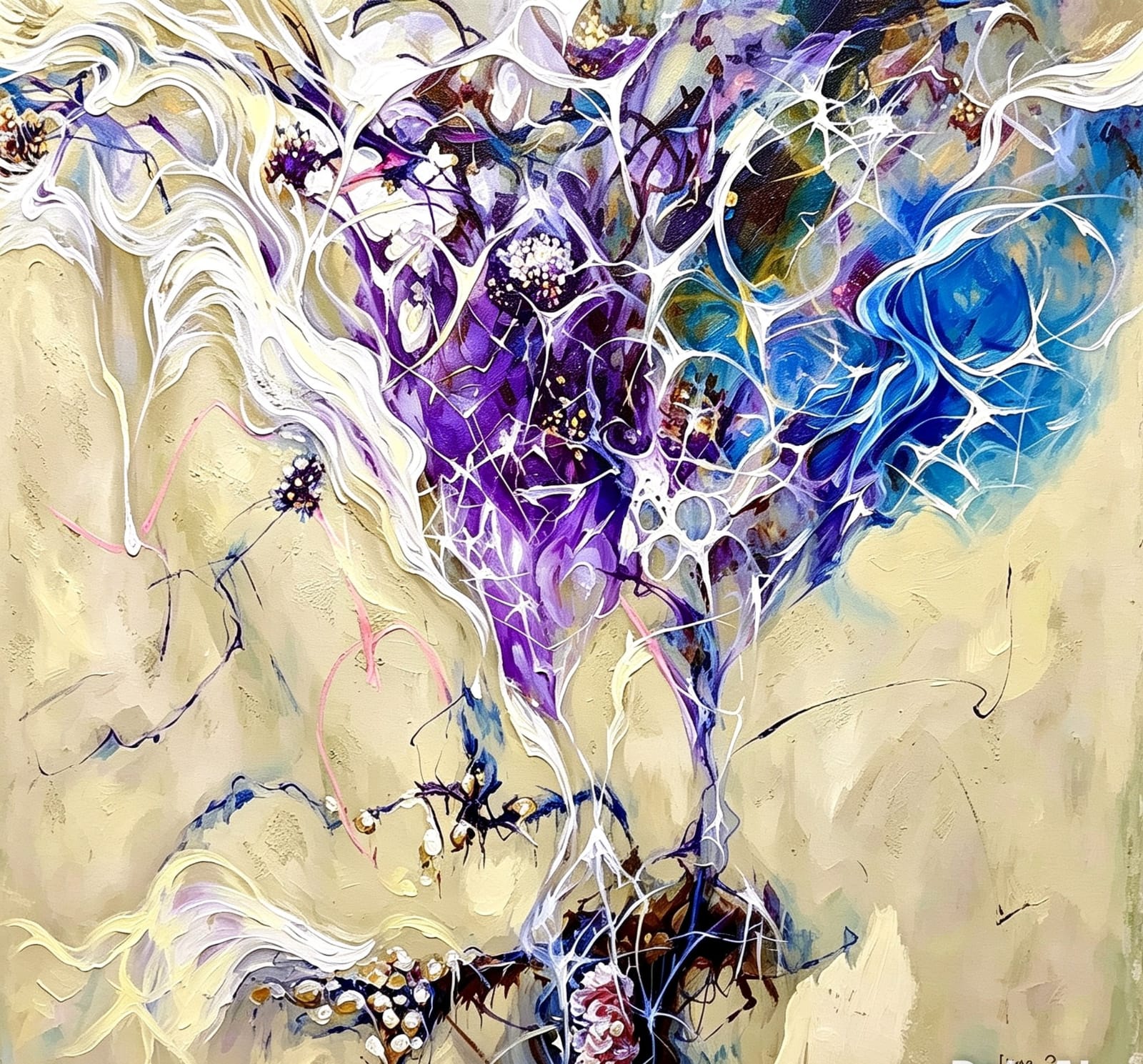
The composition of violet and blue hues, combined with flowing organic textures built from volcanic stone, crushed seashells, natural fibers, and glass, evokes the Opal's iridescent brilliance across every square centimeter of the canvas.
The surface shimmers with the same quality as the stone itself — not uniform, not predictable, always alive to the light that falls upon it.
As the world continues to evolve at unprecedented pace, the purity and uniqueness of the Opal remain unchanged.
This is Sugiartono's central statement: that in a world of constant flux and relentless acceleration, the deepest cultural values — rooted in nature, in tradition, in the slow geological patience of the earth itself — do not erode.
They endure. They illuminate.
They grow more valuable with every passing year.
A Symbol of Sundanese Identity
The Opal stands as a symbol of the enduring identity of Sundanese culture — illuminating the timeless connection between nature, tradition, and heritage that has defined this civilization since its earliest origins.
Through its radiant presence in this work, the gemstone reminds us of a truth that collectors and curators across Europe and America recognize immediately: the treasures of both nature and culture possess a lasting brilliance that no trend, no technology, and no passage of time can diminish.
This is not a painting about a gemstone.
It is a painting about permanence — and the extraordinary beauty of everything that refuses to be anything other than exactly what it is.
About the Artist
Jono Sugiartono (b. 1968, Ciamis, West Java, Indonesia) is a multidisciplinary artist whose practice bridges thousands of years of Sundanese cultural heritage with the accelerating pace of the modern age.
His visual language is deeply rooted in the Batik Mega Mendung tradition of Cirebon — reborn in luminous neural lines and organic networks that speak across civilizations. Top 10 Finalist at the UOB Painting of the Year 2023.
Honored with the Aeternum Gold distinction by international curator Antonio Pedro (Spain).
Works held in institutional collections including the Indonesian Ministry of Culture.
Represented internationally by Abstract Art Gallery, Riga.